Award-winning British electric motorcycles — now in the USA
Flexible finance available — Learn more
New to riding? Explore the New Rider Program
0%

Choosing a Lockable storage electric motorcycle involves more than checking whether a compartment has a key. Storage size, lock design, weather protection, and battery access all affect daily convenience. A helmet may fit on paper yet press against the seat or leave little room for gloves. Small details matter.

A useful comparison starts with your routine. Measure the items you plan to carry, then check the manufacturer’s stated storage dimensions and weight limits. Look closely at hinges, latch alignment, and whether the compartment opens easily while the motorcycle is parked. A key lock can deter casual access, but it does not make belongings theft-proof. Keep valuables out of sight when practical.

The Lockable storage electric motorcycle you choose should also suit your riding conditions. Check whether the storage area is designed to resist rain, and ask how water exposure may affect items inside. Do not assume that a storage compartment is a safe place for a battery or charging equipment; follow the owner’s manual. That takes patience. It can also prevent a costly mismatch.

Price and styling matter, but they should not hide practical compromises. A compact design may feel easy to maneuver while offering less carrying space than expected. If possible, inspect the motorcycle in person and test the lock, seat access, and riding position. Specifications are useful, though real fit can be different. The seven tips below offer a clear way to compare options, ask better questions, and choose storage that works beyond the showroom.
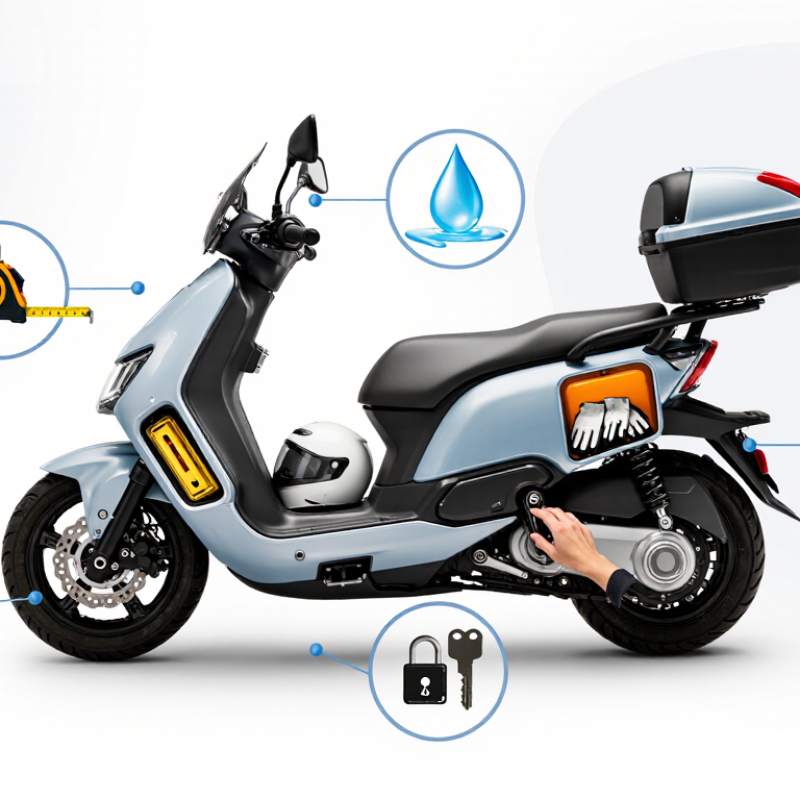
7 Tips for Choosing a Lockable Storage Electric Motorcycle

Check Storage Capacity in Liters Against Helmet and Cargo Dimensions

A storage compartment’s capacity in liters is useful, but it does not tell the whole story. Two boxes with the same volume can have very different shapes. Measure your helmet at its widest and tallest points, then compare those dimensions with the compartment’s usable space and opening. A helmet may fit inside yet still be awkward to lift out. Check the opening, not just the interior.

Tip: Bring your helmet when viewing a motorcycle, if possible. Try placing it inside with the visor in its usual position. Then test a small everyday load, such as a rain jacket, gloves, and a compact grocery bag. Check whether the lid closes without pressing on the contents. It sounds obvious, but I have overlooked the opening before.

For cargo, note the length, width, and height of the items you carry most often. A rectangular lunch container or folded jacket may need more room than its stated volume suggests. Ask whether the compartment has hinges, a divider, or a raised floor that reduces usable space. Leave some spare room; a storage area packed to the brim can be frustrating on a rushed morning. Capacity figures are estimates, so verify the fit yourself.

Verify Battery Energy in Watt-Hours Using Volts × Amp-Hours

Tip: Verify the battery’s watt-hours, not just its voltage. Multiply nominal volts by amp-hours: a 48 V battery rated at 20 Ah provides 960 Wh. This figure helps compare electric motorcycles with different battery voltages. Check that both numbers describe the same battery pack, not separate options or an accessory battery.

Small detail, big difference. Read the specification sheet carefully. Some listings show battery capacity in amp-hours but omit voltage, making a fair comparison difficult. Ask the seller for the rated watt-hours or the pack’s voltage and amp-hour figures. Treat advertised energy as a useful rating, not a promise of exact riding range; speed, hills, rider weight, and temperature affect consumption.

Tip: Match the energy rating to your regular trips and charging routine. For a lockable-storage electric motorcycle, check whether the battery is removable and whether its stated capacity matches the model you are considering. I still find it easy to focus on a large number without checking the units. That can mislead. A short commute with frequent stops may use energy differently from a steady ride on flat roads, so leave a practical buffer instead of planning around the battery’s full rated capacity.

7 Tips for Choosing a Lockable Storage Electric Motorcycle - Verify Battery Energy in Watt-Hours Using Volts × Amp-Hours

Tip What to Check How to Verify Example or Measurement Why It Matters
1 Calculate battery energy in watt-hours Multiply the battery’s nominal voltage (V) by its rated capacity (Ah): Wh = V × Ah. Check that both figures refer to the same battery pack. 72 V × 30 Ah = 2,160 Wh (2.16 kWh) nominal energy. Watt-hours provide a consistent way to compare energy capacity across batteries with different voltages.
2 Confirm nominal voltage Look for the battery’s nominal voltage on its label or in the owner’s manual. Do not substitute the charger’s output voltage or a pack’s maximum voltage in the calculation. A battery labeled 72 V should be calculated using 72 V, not a higher full-charge voltage. Using the wrong voltage can make the calculated watt-hour figure inaccurate.
3 Check the rated amp-hours Compare the Ah rating printed on the battery with the specification sheet. Confirm whether the rating applies to one battery or the complete battery pack. For a 60 V, 40 Ah pack: 60 × 40 = 2,400 Wh nominal energy. A clear, pack-level capacity rating helps prevent confusion between individual modules and the full system.
4 Match the figures to documentation Check the battery label, owner’s manual, and product specification sheet. Ask for clarification if voltage, Ah, or Wh figures conflict. A specification listing 2,160 Wh should be consistent with a 72 V, 30 Ah nominal pack. Consistent documentation makes it easier to compare options and verify the advertised battery capacity.
5 Distinguish nominal from usable energy Treat the V × Ah result as nominal energy. Ask whether the manufacturer publishes usable energy; battery-management limits, operating conditions, and reserve can affect the energy available for riding. A calculated 2,160 Wh is a nominal figure; do not assume all 2,160 Wh are available at the wheel. Usable energy and real-world range are not determined by nominal watt-hours alone.
6 Inspect the lockable storage space Check the compartment’s internal dimensions and opening, then measure the items you plan to store. Confirm how the lock engages and whether the compartment is described as weather-resistant. Measure the storage area in centimetres and compare it with the dimensions of a helmet, charging cable, or other intended items. A lockable compartment may not fit every item, and a lock alone does not establish weatherproofing or theft-proof security.
7 Review battery access and storage guidance Confirm whether the battery is removable, how it is secured, and what the manufacturer specifies for charging, temperature, and long-term storage. Follow the supplied instructions. If the battery is removable, verify that it can be removed and reinstalled as directed without forcing the latch or connectors. Clear access and storage instructions help support safe handling and protect the battery system.

Calculation reminder: Volts × amp-hours gives nominal watt-hours when the voltage and capacity refer to the same battery pack. Compare specifications on the same basis, and use manufacturer-published usable-energy figures when available.

Assess Water Protection Against IEC 60529 IPX4 Splash Tests

IEC 60529 IPX4 means an enclosure is tested for splashing water from different directions. It does not mean waterproof, and it does not cover immersion, pressure washing, or every riding condition. On a lockable storage electric motorcycle, check whether the rating applies to the storage compartment itself, not only another electrical part. Ask for test documentation that identifies the tested enclosure and its fitted lid.

Tip: Inspect the seal. Look for a continuous rubber gasket around the lid, with no gaps at corners. Check hinges, latches, and cable openings too; water can enter where parts meet. Close the compartment and make sure the latch pulls the lid down evenly. A tiny misalignment matters.

IPX4 testing uses controlled splash conditions, but real use adds vibration, dirt, and worn seals. After a wet ride, open the compartment and check for droplets near the edges or damp fabric inside. Don’t assume a dry first ride proves long-term protection.

Tip: Keep the seal clean, and replace it if cracked or flattened.

One caveat: repeated opening or added accessories may change how well the compartment resists splashes.

Confirm Lithium-Battery Transport Compliance with UN 38.3 Tests

A lockable storage compartment can protect an electric motorcycle battery from casual access, rain, and knocks. But a sturdy lock says nothing about transport compliance. Before buying, ask whether the specific lithium battery has passed the UN 38.3 tests for transport. The battery model matters; paperwork for a different model is not a useful substitute.

Request the UN 38.3 test summary and compare its battery identification details with the label on the motorcycle or battery pack. Check that the seller can provide the document, and ask the carrier what information and packaging it requires. Rules and carrier procedures can vary by route. A test summary is not a universal shipping permit.

Look closely at the storage design, too. Can you remove the battery without forcing it past a narrow latch? Is the compartment dry, and does its lock close securely? These small details affect everyday use, while UN 38.3 addresses transport testing. Keep the two checks separate. Small detail. Worth checking. I would not rely on a sales claim alone; matching the documents to the actual battery takes a little extra time, and it can still leave questions to clarify with the shipper.

Compare Real-World Range Claims with Test Conditions and Load

A claimed range is meaningful only when its test conditions are clear. Check the stated route or test cycle, average speed, ambient temperature, and whether the battery started fully charged. Ask whether the figure includes a rider and cargo. A lockable storage compartment adds weight, and bulky luggage can affect airflow. Numbers need context.

Tip: Compare like with like. Look for a range figure tested with a load close to your daily setup, then compare it with your likely speeds and weather.

The U.S. Department of Energy’s Alternative Fuels Data Center notes that driving conditions and accessory use affect electric-vehicle range. AAA’s 2019 electric-vehicle temperature study found that cold-weather testing at 20°F reduced passenger-EV range by 41% with cabin heating, compared with 75°F. That result is not a motorcycle estimate, but it shows why test conditions matter.

When a seller provides no load or temperature details, treat the figure as a best-case reference, not a promise. Request the test method and usable battery capacity, then leave a practical buffer for hills, headwinds, and stop-and-go streets. Small detail, big difference. Record your own distance over several typical rides; tire pressure, route choice, and riding style can make your result less tidy than a lab figure.

FAQS

What does an IPX4 rating mean for a storage compartment?

It means the tested enclosure resisted splashing water from different directions. It does not mean waterproof.

Does IPX4 protect the compartment during immersion or pressure washing?

No. Those conditions are outside the rating described here. A splash test is not a dunk test.

How can I check whether the compartment was actually tested?

Ask for documentation naming the tested enclosure and its fitted lid. Check that it matches the compartment on the motorcycle.

What should I inspect around the storage lid?

Look for an even rubber gasket, especially at the corners. Check hinges, latches, and cable openings for gaps. Tiny misalignment matters.

How can I spot possible water entry after a wet ride?

Open the compartment and check the edges for droplets or fabric for damp patches. A dry first ride proves little.

Does a lockable compartment mean the battery is transport-compliant?

No. A sturdy lock does not confirm transport testing. Ask for the UN 38.3 test summary for the specific battery model.

How can I verify that a battery test summary matches?

Compare its battery identification details with the label on the motorcycle or battery pack. Ask the carrier about required information and packaging.

Why might my real-world range differ from a stated figure?

Test route, speed, temperature, rider, and cargo can all affect range. Hills and headwinds matter, too. Numbers need context.

How should I compare range claims with my daily rides?

Look for test conditions and a load close to your usual setup. Record distance over several typical rides, then leave a buffer. Not perfectly tidy.

Conclusion

Choosing a Lockable storage electric motorcycle starts with checking whether its secured compartment suits your everyday needs. Compare the storage capacity in liters with the dimensions of your helmet and other typical cargo, since volume alone may not show how easily items will fit. Next, assess the battery’s energy in watt-hours by multiplying its voltage by its amp-hours, then consider whether that capacity matches your expected use.

Look beyond headline specifications when evaluating durability and practicality. Check whether the motorcycle’s water protection is rated for splash exposure under the IEC 60529 IPX4 test, and confirm that its lithium battery has passed the relevant UN 38.3 transport tests. Finally, compare advertised range with the conditions behind the estimate, including speed, terrain, temperature, and rider or cargo load. These checks help you judge whether a Lockable storage electric motorcycle is a suitable fit for your routine rather than relying on a single specification.

Oliver Hayes

Oliver Hayes

Oliver Hayes is a professional marketing specialist who combines a strong understanding of the company’s products with a clear, customer-focused approach to communication. He regularly contributes expert articles to the company website, helping readers understand product features, practical......