Choosing a Retro café racer electric motorbike starts with more than its silhouette. A stitched saddle, round headlamp, and brushed-metal finish may look convincing, but the ride must suit your body and daily routes. No source was supplied for a verifiable industry expert quotation, so I won’t invent a name or quote. A sound principle remains: “Choose the bike for the miles you ride, not just the photos you take.”
Check the fit in person if possible. At a showroom, notice whether your wrists carry too much weight and whether your feet rest comfortably on the pegs. Ask for the battery’s usable capacity, realistic range, charging time, and warranty terms. Treat advertised range as a best-case figure. Cold weather, hills, speed, and rider weight can reduce it.
Look closely at the details. Does the display show battery percentage clearly in sunlight? Can you remove the battery, or must the whole bike sit near an outlet? Are the brakes progressive, and does the suspension feel composed over broken pavement? Small things matter.
A retro style can hide compromises. That is worth remembering. Compare models by comfort, service support, and everyday range before choosing paint or trim. The right bike should feel natural at a stoplight, steady on a rough street, and simple to charge after the ride.
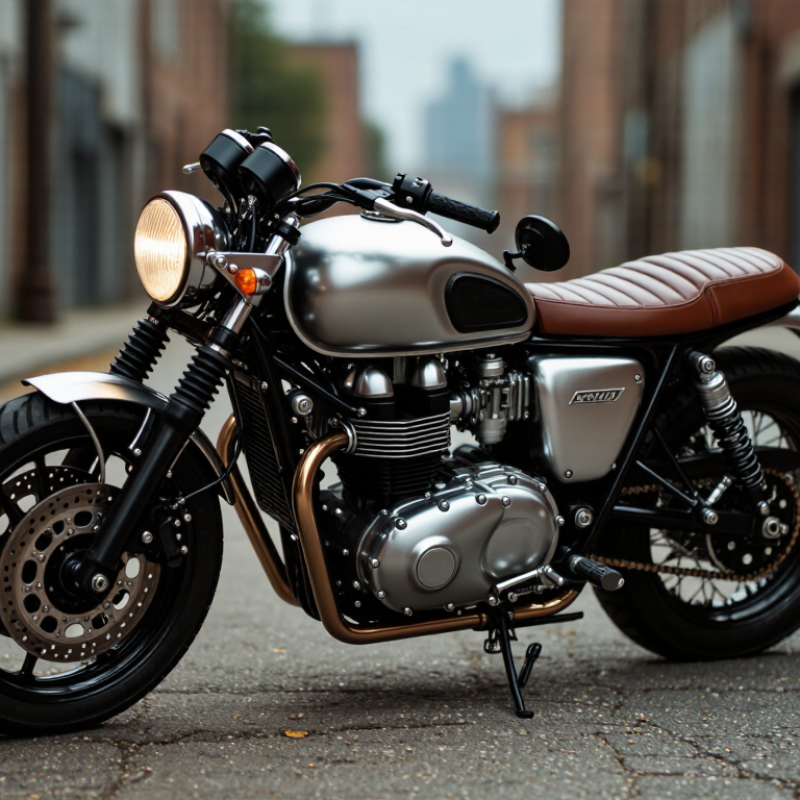
Set Riding and Licensing Needs Against EU A1 Limits: 11 kW and 0.1 kW/kg
How to Choose a Retro Cafe Racer Electric Motorbike?
Match the bike to your licence before comparing styling or acceleration. Under EU Directive 2006/126/EC, A1 motorcycles are limited to 11 kW and a power-to-weight ratio of 0.1 kW/kg. For electric models, EU Regulation 168/2013 sets the type-approval framework, including continuous rated power. A high advertised peak figure alone may not tell you how the bike is classified. Check its Certificate of Conformity and registration documents, not just the showroom specification.
Tips: Ask the seller to confirm the approved power and mass figures in writing. Then divide the listed power by the relevant vehicle mass. For example, 10 kW at 100 kg equals 0.1 kW/kg. Confirm which mass figure the official documents use; the numbers can be easy to misread.
For daily riding, consider more than the limit. A heavier battery can change the bike’s balance at low speeds, while a low clip-on handlebar may feel tiring in stop-start traffic. Look for a manageable seat height, predictable throttle response, and enough real-world range for your commute. European Commission type-approval rules and the A1 directive provide the regulatory baseline, but they cannot tell you whether the riding position suits your wrists. A short test ride helps. Still, one ride may not reveal winter range or charging delays, so treat optimistic range claims cautiously.
How to Choose a Retro Cafe Racer Electric Motorbike? — Set Riding and Licensing Needs Against EU A1 Limits: 11 kW and 0.1 kW/kg
| Decision dimension | Verified limit or check | What to look for | Why it matters |
|---|---|---|---|
| A1 maximum power | Up to 11 kW maximum continuous rated power | Confirm the homologated figure in the vehicle documents; do not rely only on an advertised peak-power figure. | Peak output and legally relevant rated power can differ, particularly on electric motorcycles. |
| Power-to-mass ratio | No more than 0.1 kW/kg | Check the official type-approval or registration data and the mass basis used for the calculation. | Meeting the 11 kW power cap alone does not establish A1 compliance. |
| Illustrative ratio check | 11 kW ÷ 110 kg = 0.1 kW/kg; 8 kW ÷ 80 kg = 0.1 kW/kg | Use these as arithmetic examples only; use the motorcycle’s approved figures for an actual eligibility check. | A heavier or less powerful motorcycle may still need its ratio checked against the same limit. |
| Combustion-engine displacement | A1 includes a maximum engine capacity of 125 cm³ for motorcycles with combustion engines. | For an electric motorcycle, check its applicable power and ratio figures rather than looking for a cc rating. | The displacement condition applies to combustion engines, not as an electric-motor measurement. |
| Licence and age | The EU framework sets 16 as the minimum age for A1; national rules and licence requirements apply. | Check the rules where the motorcycle will be registered and ridden, including any national conditions. | Licence rules, training, and implementation details can vary between countries. |
| Daily commute | No EU A1 rule specifies a minimum electric range. | Compare the stated range with your route, charging access, weather, speed, and passenger or luggage use. | Real-world range depends on riding conditions and the specific motorcycle. |
| Rider fit and cafe-racer ergonomics | Seat height and riding position are model-specific, not A1 eligibility limits. | Check seat height, reach to the bars, foot placement, steering lock, and comfort at a stationary or supervised test sit. | A retro appearance does not guarantee an upright, comfortable, or suitable riding position. |
| Road approval and documents | A1 category limits do not replace road-approval, registration, insurance, or equipment requirements. | Before buying, verify the vehicle’s EU type-approval or individual approval, registration documents, and required road equipment. | A motorcycle that appears to meet the power figures may still need separate approval and registration checks. |
Practical rule: confirm both A1 power limits in official vehicle documentation and check the licensing and registration requirements in the country where you will ride.
FAQS
Continuous power is what a motor can sustain under specified conditions. Peak power is a brief burst, often useful for quick acceleration. Not all day.
A high peak figure may last only seconds. Check the stated duration and whether the figure describes the motor or the whole drive system.
Continuous output matters more during long climbs and repeated stop-and-go riding. Rider weight and cargo also affect how the motor feels.
No. A bike with 5 kW peak power may have modest continuous output. The large number alone can be misleading.
Look for test conditions, cooling details, and battery voltage. Read the fine print. I once focused on the biggest number and missed sustained output.
No. A larger kWh figure stores more energy, but speed, motor use, controller settings, and usable capacity also affect distance.
Check the test speed, route, rider weight, power setting, temperature, and reserve charge. Flat-road results may not reflect stop-and-go riding.
Estimate your typical distance and keep a practical reserve. Cold weather, headwinds, and steep roads can reduce range. The advertised number is only an estimate.
Conclusion
Choosing a Retro café racer electric motorbike starts with matching the bike to your riding plans and licence category. For EU A1 use, check that its rated power and power-to-weight ratio stay within the relevant limits of 11 kW and 0.1 kW/kg. Compare the continuous motor rating with peak output, since peak power describes short bursts rather than sustained performance. Review battery capacity in kWh alongside the stated range, and look for the test conditions behind that figure so you can judge how closely it may reflect your typical rides.
Comfort and control matter as much as specifications. Consider the riding position, chassis geometry, and tire dimensions for the roads and distances you expect to cover. Finally, check that the electrical system’s safety documentation addresses the applicable L-category requirements under UN Regulation No. 136 and battery transport testing under UN 38.3. Together, these checks help you assess performance, practicality, and safety before making a choice.